Norton Fire Offers Safety Tips for Cooking This Holiday Season

Norton Fire Offers Safety Tips for Cooking This Holiday Season

NORTON — Chief Shawn Simmons and the Norton Fire Department wish to share safety tips with community members as they plan to cook, bake and enjoy holiday meals over the coming days and weeks.

According to the National Fire Protection Association (NFPA), Thanksgiving, Christmas and Christmas Eve are peak days for home cooking fires. During 2017–2021, unattended cooking was the leading factor contributing to cooking fires and casualties.

To help prevent cooking fires and burn injuries this holiday season, community members are encouraged to review the following tips from the NFPA.

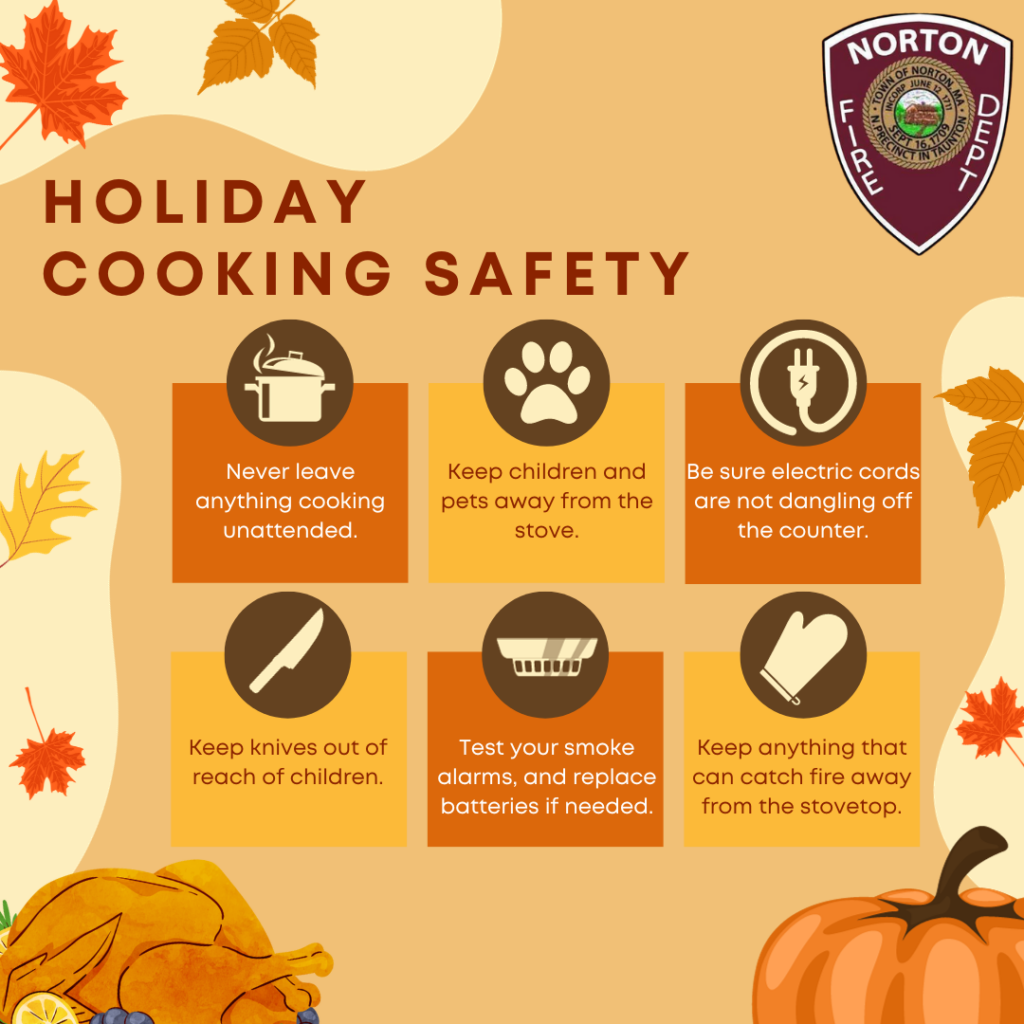
  • When using the stovetop, never leave anything cooking unattended. Stay in the kitchen when you are cooking on the stovetop so you can keep an eye on the food.
  • When simmering, baking or roasting food, check it regularly, remain in the kitchen while the food is cooking and use a timer to remind you that you are cooking.
  • When frying or sautéing, heat oil slowly to the temperature you need. Add food gently to the pot or pan so the oil does not splatter. If you see wisps of smoke or the oil smells while cooking, immediately turn off the burner and/or carefully remove the pan from the burner. Smoke is a danger sign that the oil is too hot.
  • Keep anything that can catch fire — oven mitts, wooden utensils, food packaging or towels — away from your stovetop.
  • Keep children and pets at least three feet away from the stove.
  • Make sure kids stay away from hot food and liquids. The steam or splash from things like vegetables, gravy or coffee could cause serious burns.
  • Keep knives out of the reach of children.
  • Be sure electric cords from an electric knife, coffee maker, plate warmer or mixer are not dangling off the counter within easy reach of a child.
  • Keep the kitchen and dining room floor clear so you don’t trip over kids, toys, bags or other items while cooking or handling food.
  • Test your smoke alarms before cooking and make sure the batteries are replaced if needed.
  • If you have a cooking fire:
    • If a small grease fire starts in a pan, smother the flames by carefully sliding the lid over the pan. Turn off the burner and do not move the pan. To keep the fire from restarting, leave the lid on until the pan is completely cool.
    • If a fire starts in the oven, turn off the oven and leave the door closed. The oven should be checked and/or serviced before being used again.
    • If you try to fight the fire, be sure others are getting out and you have a clear way out. Just get out! When you leave, close the door behind you to help contain the fire. Call 911 after you leave.

Additionally, the NFPA strongly discourages the use of deep fryers for cooking turkeys. For a safe alternative, NFPA recommends purchasing a fried turkey from a grocery store or restaurant or buying a fryer that does not use oil. Those who do use a fryer should use it on a sturdy, flat surface that is outdoors and at least 10 feet away from structures, including porches. Turkeys should be completely thawed and dried before being placed in a deep fryer to avoid flare-ups.

The Norton Fire Department wishes everyone a safe, happy and healthy holiday season.

###
Norton Fire Reminds Residents to Change Their Clocks, Check Their Alarms as Daylight Saving Time Ends

Norton Fire Reminds Residents to Change Their Clocks, Check Their Alarms as Daylight Saving Time Ends

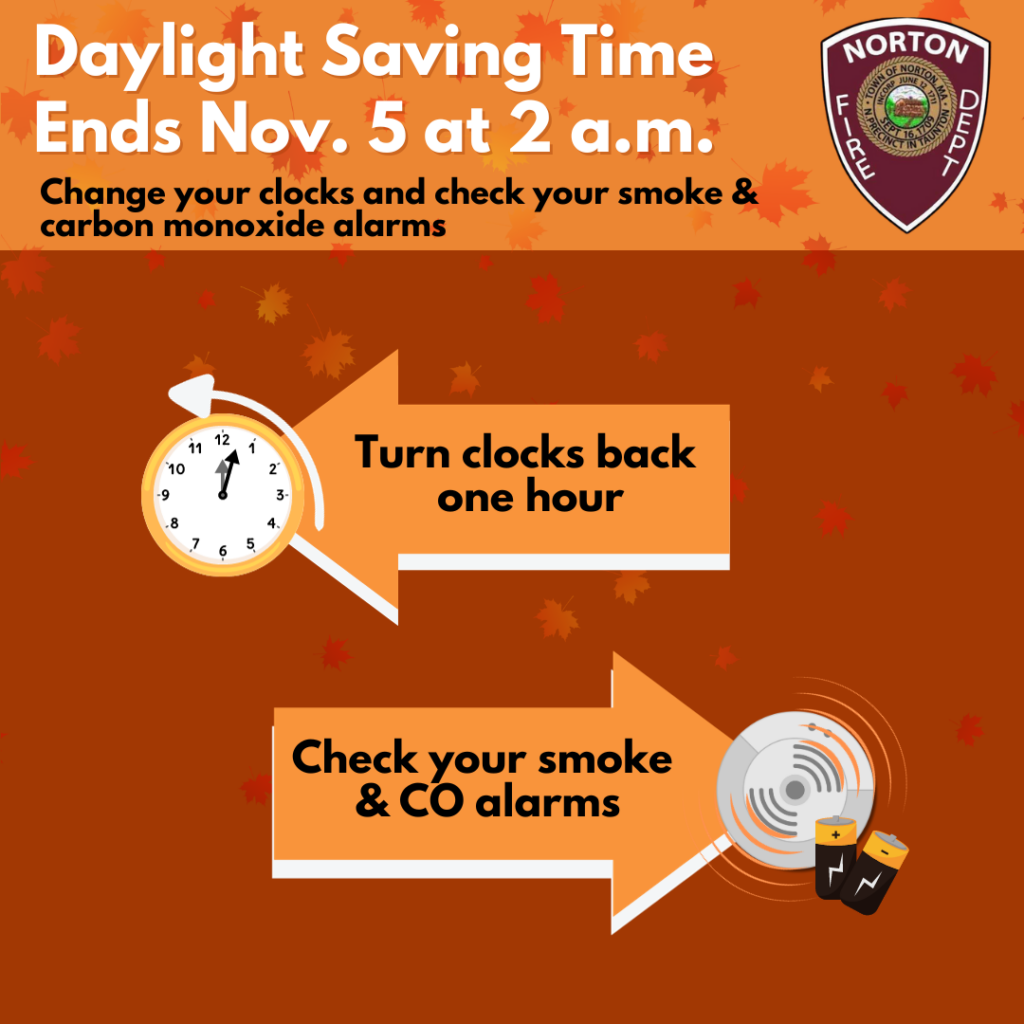
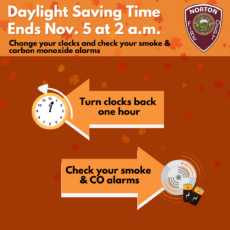
NORTON — Chief Shawn Simmons and the Norton Fire Department would like to remind residents to check their smoke and carbon monoxide alarms when setting their clocks back for Daylight Saving Time this weekend.

Daylight Saving Time ends on Sunday, Nov. 5, at 2 a.m., and clocks will move back one hour at that time.

When changing their clocks in the spring and fall, residents are also encouraged to check their smoke and carbon monoxide alarms. If the alarms take alkaline batteries, residents should change the batteries when changing their clocks. If the alarms are out of date, they should be replaced.

Smoke alarms that are properly installed and maintained are vital in reducing deaths and injuries due to a fire by giving everyone in the home an early warning and time to escape.

According to the National Fire Protection Association (NFPA), from 2014-2018 three out of five home fire deaths resulted from fires in homes with no smoke alarms (41%) or no working smoke alarms (16%). In fires in which the smoke alarms were present but did not operate, two of every five (41%) of the smoke alarms had missing or disconnected batteries.

Residents are encouraged to review the following safety tips, courtesy of the NFPA:

  • Test all smoke alarms at least once a month by pressing the test button to ensure the alarm functions properly.
  • Smoke alarms with non-replaceable 10-year batteries are designed to remain effective for up to 10 years. If the alarm chirps, warning that the battery is low, replace the entire smoke alarm right away.
  • Alarms with any other type of replaceable battery need a new battery at least once a year. When you change your clocks, also replace regular batteries in smoke and carbon monoxide alarms.
    • When replacing a battery, follow the manufacturer’s instructions, which specify the batteries (brand and model) that must be used. The smoke alarm may not work properly if a different kind of battery is used.
  • Replace all smoke alarms when they are 10 years old. CO alarms should be replaced according to the manufacturer’s instructions.
  • Install smoke alarms in every bedroom. They should also be outside each sleeping area and on every level of the home. Install alarms in the basement.
  • CO alarms should be installed in a central location outside each bedroom or sleeping area, on every story of the home and in other locations required by standards, codes or laws.
  • People who are hard of hearing or deaf can use special alarms. These alarms have strobe lights and bed shakers.
  • For the best protection, interconnect alarms throughout the home. When one sounds, they all sound.
  • When an alarm sounds, immediately exit the house or building and ensure each person inside the home is accounted for. Call 9-1-1, wait for emergency personnel and stay out of the building.
  • Working with each member of the household, create and practice a home escape plan.
  • More tips about installing and maintaining smoke alarms can be found here, and carbon monoxide alarms here.

Today’s smoke alarms are more technologically advanced to respond to a multitude of fire conditions, yet mitigate false alarms. Residents are reminded that separate smoke and carbon monoxide alarms are not interchangeable and should never be disconnected.

###

During Fire Prevention Week Norton Fire Department Urges Residents to Be Aware: ‘Cooking Safety Starts with YOU. Pay Attention to Fire Prevention.’

During Fire Prevention Week Norton Fire Department Urges Residents to Be Aware: ‘Cooking Safety Starts with YOU. Pay Attention to Fire Prevention.’

NORTON — During Fire Prevention Week, which is being recognized this year from Oct. 8 to 14, Chief Shawn Simmons and the Norton Fire Department are sharing important cooking safety tips to help keep residents safe.

Fire Prevention Week is organized by the National Fire Protection Association (NFPA). The goal of Fire Prevention Week is to educate the public about simple but important ways they can keep themselves and those they live with safe.

This year’s theme, “Cooking safety starts with YOU. Pay Attention to Fire Prevention” aims to educate everyone about simple but important actions they can take to keep themselves and those around them safe when cooking.

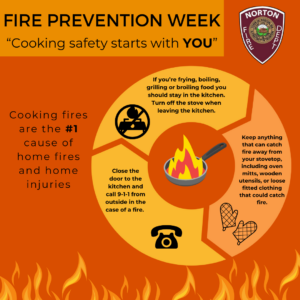
According to the NFPA, cooking fires are the number one cause of home fires and home injuries and unattended cooking is the leading cause of cooking-related fires and deaths.

Norton Fire Department and the NFPA urge all community members to take the following steps to ensure they are cooking safely and are actively preventing cooking fires:

  • Cook with Caution: Never use the stove or stovetop if you’re tired or have consumed alcohol.
  • If you’re frying, boiling, grilling or broiling food you should stay in the kitchen. Turn off the stove when leaving the kitchen.
  • If you’re simmering, baking or roasting food, check it regularly, remain in the home while food is cooking, and use a timer as a reminder.
  • Keep anything that can catch fire — oven mitts, dish towels, wooden utensils, food packaging, or curtains away from the stovetop.
  • Keep children and pets away from hot food and liquids. The steam or splash from vegetables, gravy, coffee and other food and drink could cause serious burns.
  • Be sure electric cords from an electric knife, coffee maker, plate warmer or mixer are not dangling off the counter within reach of a child.
  • Keep matches and utility lighters out of the reach of children. They should be kept up high in a locked cabinet.
  • Keep the kitchen and dining room floor clear so there is less risk of tripping.
  • For a small stovetop fire, smother the flames by sliding a lid over the pan and turn off the burner. Leave the pan covered until it is completely cooled.
  • For an oven fire, turn off the heat and keep the door closed. The oven should be checked and/or serviced before being used again.
  • Test your smoke alarms and make sure the batteries are replaced if needed.
  • Close the door to the kitchen and call 9-1-1 from outside in the case of a fire.

Residents are also reminded of the importance of having large and clearly visible house numbers to help first responders easily find your home. Numbers should be facing the street, should be visible at night and should not be blocked by trees or bushes. Those with long driveways should have house numbers on both sides of a mailbox or sign pole at the end of their driveway near the roadway.

To learn more about Fire Prevention Week, click here.

###

Norton Fire Department Offers Safety Tips, Encourages Residents to Stay Alert as Hurricane Lee Projected to Track Toward New England

Norton Fire Department Offers Safety Tips, Encourages Residents to Stay Alert as Hurricane Lee Projected to Track Toward New England

NORTON — Chief Shawn Simmons and the Norton Fire Department ask residents to remain alert and take necessary precautions as Hurricane Lee is expected to track toward New England in the coming days.

According to the National Hurricane Center, Lee is moving toward the north-northwest and a turn toward the north is expected by tonight.

Public safety officials are receiving briefings as the situation is updated, and are staying current on storm tracks and forecasts to ensure staffing is in place to deal with any emergency.

Hurricanes can bring many different types of wind and water hazards, including storm surges, strong winds and flooding. The Department of Homeland Security (DHS) and the Federal Emergency Management Agency (FEMA) offer several tips to help residents better prepare for extreme weather:

Know Your Evacuation Zone

Learn if you live or work in a hurricane evacuation zone. If you live in an area that may flood and you may need assistance evacuating, plan with family, neighbors, and friends to determine who may be able to assist. Contact your local public safety officials to make them aware of your needs.

Make an Emergency Plan

Have an emergency plan for how your family would communicate, evacuate, and shelter in place that addresses the needs of all family members, including seniors, children, individuals with access and functional needs, and pets. If you receive medical treatment or home health care services, work with your medical provider to determine how to maintain care and service if you are unable to leave your home or have to evacuate.

Steps to making an emergency plan include:

  • Discuss the questions below with your family, friends or household to start your emergency plan.
    • How will I receive emergency alerts and warnings?
    • What is my shelter plan?
    • What is my evacuation route?
    • What is my family/household communication plan?
  • Consider specific needs in your household.
  • Fill out a Family Emergency Plan. A sample plan can be found here.
  • Practice your plan with your family/household.

Build an Emergency Kit

Build an emergency kit that will sustain your household for three to five days without power.

A basic emergency supply kit may include the following recommended items:

  • Food and water
  • Battery-powered or hand crank radio and a NOAA Weather Radio with tone alert
  • Flashlight and extra batteries
  • First aid kit, including prescription medicine
  • Disinfectants, moist towelettes, hand sanitizer, and cleaning supplies
  • Whistle (to signal for help)
  • Dust mask (to help filter contaminated air)
  • Plastic sheeting and duct tape (to shelter in place)
  • Moist towelettes, garbage bags, and plastic ties (for personal sanitation)
  • Wrench or pliers (to turn off utilities)
  • Manual or battery-powered can opener (for food)
  • Local maps
  • Cell phone with chargers and a backup battery

Preparing at home

  • Check flashlights and portable radios to confirm they’re working. Fully charge your cell phone, laptop and any other devices before the storm.
  • Check the batteries in smoke and carbon monoxide detectors.
  • If you own a car, make sure the gas tank is at least half full should you need to travel.
  • Have an emergency food supply in case of a power outage. People should have supplies to sustain their families for at least 72 hours.
  • Set your refrigerator and freezer to their coldest settings (remember to reset them back to normal once power is restored). During an outage, minimize the number of times you open the refrigerator or freezer door.
  • Prepare your home by securing or bringing in outdoor objects (patio furniture, children’s toys, trash cans, etc.) that could be swept away or damaged during strong winds or flooding. Also, elevate items in your basement in case of flooding, check your sump pump, unplug sensitive electronic equipment, and park vehicles in areas that are unlikely to flood.
  • Bring in boats from moorings or add extra lines to secure them. The Harbormaster will not be responding to boats off of mooring until the storm weakens and it is safe for the crews to respond.
  • The Massachusetts Emergency Management Agency recommends purchasing a generator to maintain electricity in an outage. NEVER run a generator indoors, in a garage, or with the exhaust facing the home or home air intakes.
  • Pack a bag with important items in case you need to evacuate. Don’t forget to include needed medications and any valuable personal belongings.

Should a Weather Event Occur

  • Don’t go out during a hurricane or tropical storm, if possible.
  • Call 9-1-1 to report emergencies, including downed power lines and gas leaks.
  • Stay away from downed utility wires. Always assume a downed power line is live.
  • Report power outages to your utility company. Do not call 9-1-1 to report an outage or to ask about power restoration. 
  • Be a good neighbor. Check on family, friends, and neighbors, especially the elderly, those who live alone, those with medical conditions and those who may need additional assistance.

Stay Informed

Every family should have multiple methods for receiving emergency alerts. Learn more about different types of alerting and information tools including the Emergency Alert System, Wireless Emergency Alerts, NOAA Weather Radio, social and traditional news media, and your local notification systems.

For more information on hurricane planning, click here.

###

Retired Norton Fire Chief George F. Burgess Obituary

Retired Norton Fire Chief George F. Burgess Obituary

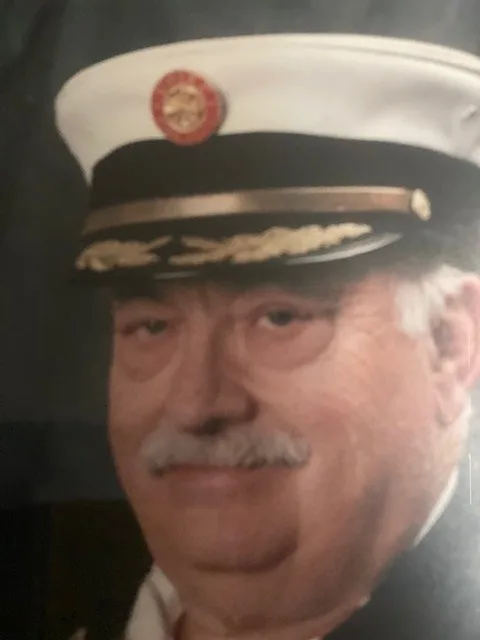
Retired Norton Fire Chief George F. Burgess, 84

Dateline: Norton, MA

Retired Norton Fire Chief George F. Burgess, age 84, of Norton, passed away peacefully, in the presence of his loving family on Friday, September 1, 2023 at the Sturdy Memorial Hospital in Attleboro. He was the beloved husband and best friend of the late Deborah A. (Wills) Burgess, to whom he was wed for fifty-nine years at the time of her death on September 19, 2022.

Born in Attleboro, MA on August 4, 1939, he was a loving son of the late Edward L. Burgess and Norma B. (Keene) Story.

George spent his early childhood living in Attleboro. At the age of twelve his family moved to the Chartley section of Norton, where he has made his home ever since. He was a 1957 graduate of Norton High School and served his country as a member of the United States Army Reserve. Chief Burgess loved spending time with his adoring family and friends, especially while relaxing in the beautiful White Mountains of New Hampshire.

Chief Burgess began his career as a Norton Firefighter at the age of fifteen and was appointed fulltime to the department in 1962. He became Fire Chief in 1971 and at the age of sixty-five retired following thirty-three years as Chief. He had a special love for the Community of Norton, especially for the firefighters that worked under his command. In recognition of his many years of faithful service to the people of Norton, Station 2 on East Main Street was named in his honor.

George also served on the Norton Planning Board, was a Charter Member of the Norton Fire Fighters Local 2678, a former president of the Massachusetts Fire Chiefs Association, a member of the Bristol County Fire Chiefs Association, as well as a member of the New England Fire Chiefs Association.

He is survived by his devoted sons: Norton Firefighter Edward L. Burgess and his wife Jane of Norton, Mansfield Fire Captain William H. Burgess and his wife Judy of Norton and retired Norton Fire Lieutenant Andrew V. Burgess and his longtime companion Gena Brasil of Norton. He was the cherished grandfather of Sarah, Emily, Rachel, Kelsie, Meghan, Jacob, Ben, Will, Grace and the great grandfather of Meadow, August and Isabella. He was the dear brother of Joanne F. Lund of Norton and is also survived by his loving nieces and nephews.

Relatives and friends are cordially invited to attend visiting hours with Firefighters Honors on Wednesday, September 6th from 4:00-7:00 P.M. in Saint Mary’s Church, 1 Power Street, Norton.

His funeral service will be held on Thursday, September 7th at 10:00 A.M. in Saint Mary’s Church, Norton. Following the services, a procession will leave for the George F. Burgess Station 2 on East Main Street in Norton for a traditional firefighters last call. Burial will be private.

In lieu of flowers, George’s family has requested that donations in his memory be made to the Norton Firefighters Local 2678, 70 East Main Street, Norton, MA 02766.

Arrangements are under the care and direction of the Norton Memorial Funeral Home, 19 Clapp Street, Norton.

To send his family a message of condolence, please visit www.nortonmemoroail.com

Obituary courtesy Norton Memorial Funeral Home.

Norton Fire Department Offers Water Safety Tips for Those In or Near Bodies of Water This Summer

Norton Fire Department Offers Water Safety Tips for Those In or Near Bodies of Water This Summer

NORTON — Fire Chief Shawn Simmons and the Norton Fire Department would like to remind residents to act safely and responsibly when visiting lakes, ponds and other bodies of water this summer.

According to the American Red Cross, 10 people die each day from unintentional drowning, and on average two of those deaths are children under age 14. Additionally, drowning is the leading cause of death for children and adults with autism spectrum disorder.

To ensure everyone’s safety in the water this summer, the Norton Fire Department would like to offer the following safety tips to kayakers, paddlers, and recreational boaters courtesy of the American Canoe Association:

  • Always wear a U.S. Coast Guard-approved life jacket when boating or fishing, even if you don’t intend to enter the water.
  • Children under the age of 12 must always wear a life jacket in a public body of water.
  • Be a competent swimmer with the ability to handle oneself underwater, moving water, surf or current. Keep the craft under control. Do not enter a rapid unless you are reasonably sure you can navigate it or swim the entire rapid in case you capsize.
  • Keep a lookout for hazards and avoid them. Watch for fog, especially on coastal waters.
  • Know your physical limitations.
  • Group members need to constantly assess the behavior of others in their group.

For those swimming in the ocean, lakes, ponds or pools, the Norton Fire Department  also offers the following safety tips outlined by the American Red Cross:

  • Never leave children unattended while they are near or in a body of water, and make sure they have an adult to accompany them into the water. Young or inexperienced swimmers should always wear a life jacket or inflatable arm floats.
  • Never swim alone; swim with lifeguards and/or water watchers present. Even if lifeguards are present, you (or another responsible adult) should stay with your children.
  • If a child is missing, always check the body of water that they were near or swimming in first.
  • Understand and adjust for the unique risks of the water environment you are in, such as river currents, ocean rip current, underwater hazards including vegetation and animals, and more.
  • Don’t use alcohol or drugs (including certain prescription medications) before or during swimming or diving, or while supervising swimmers.
  • Recognize the signs of someone in trouble and shout for help. A swimmer needs immediate help if they:
    • Are not making forward progress in the water.
    • Are vertical in the water but unable to move or tread water.
    • Are motionless and face down in the water.
  • If someone is drowning or experiencing an emergency in the water:
    • Rescue and remove the person from the water (without putting yourself in danger).
    • Ask someone to call 911
    • Begin CPR and use an AED if available.
  • Take a CPR course for adults and children to be prepared if an emergency occurs. Update skills regularly.

###

Norton Fire Department Reminds Residents of Important Preparedness Activities During Hurricane Preparedness Week

Norton Fire Department Reminds Residents of Important Preparedness Activities During Hurricane Preparedness Week

Fire Chief Shawn Simmons and the Norton Fire Department wish to share guidance on hurricane awareness and preparedness this season.

Gov. Maura Healey has proclaimed July 9-15 as Hurricane Preparedness Week in Massachusetts, which recognizes the importance of preparing for the impact of extreme weather.

June 1 marked the official start of the Atlantic Hurricane Season, which runs through Nov. 30. Most hurricanes and tropical storms that impact New England occur during late August and September, and residents are encouraged to prepare early.

Hurricanes can bring many types of wind and water hazards, including storm surges, strong winds and flooding. The Department of Homeland Security and the Federal Emergency Management Agency (FEMA) offer several tips to help residents better prepare for extreme weather should it occur.

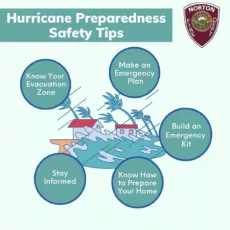
Know Your Evacuation Zone: Learn if you live or work in a hurricane evacuation zone. The best action to protect yourself and your family from the flooding and high winds caused by hurricanes is to evacuate when ordered to do so, before those conditions hit your area. Know and follow the directions from local officials for community evacuation and follow posted evacuation routes.

Visit www.mass.gov/knowyourzone to learn if you live or work in a hurricane evacuation zone. If you live in an area that may flood and may need assistance evacuating, plan with family, neighbors, and friends who may be able to assist, and contact your local public safety officials to make them aware of your needs.

Make an Emergency Plan: Have an emergency plan for how your family would communicate, evacuate and shelter in place should there be an emergency. An emergency plan should address the specific needs of all of your family members and those you are responsible for.

Steps to making an emergency plan include the following:

  • Discuss the questions below with your family, friends, or household:
    • How will I receive emergency alerts and warnings?
    • What is my shelter plan?
    • What is my evacuation route?
    • What is my family/household communication plan?
  • Consider specific needs for everyone in your household, including seniors, children, individuals with access and functional needs, and pets. Dietary needs, medical needs including prescriptions and equipment, disabilities or access and functional needs including devices and equipment, and cultural and religious considerations should all be taken into account when creating an emergency plan.
  • Fill out a Family Emergency Plan. A sample plan can be found here.
  • Practice your plan with your family/household.

Build an Emergency Kit: Build an emergency kit that will sustain your household for 3-5 days without power. A basic emergency supply kit might include the following recommended items:

  • Food and water
  • Battery-powered or hand-crank radio and a NOAA Weather Radio with tone alert
  • Flashlight and extra batteries
  • First aid kit
  • Whistle (to signal for help)
  • Dust mask (to help filter contaminated air)
  • Soap, hand sanitizer, and disinfecting wipes
  • Prescription and non-prescription medications
  • Eyeglasses and contact lens solution
  • Infant formula, bottles, diapers, and wipes
  • Important family documents, and cash or traveler’s checks
  • Plastic sheeting and duct tape (to shelter in place)
  • Moist towelettes, garbage bags, and plastic ties (for personal sanitation)
  • Wrench or pliers (to turn off utilities)
  • Manual can opener (for food)
  • Local maps
  • Cell phone with chargers and a backup battery

Store items in airtight plastic bags and put your entire disaster supplies kit in one or two easy-to-carry containers such as plastic bins or a duffel bag.

Prepare Your Home: You can improve your home’s ability to withstand hurricane conditions. Consider cutting weak branches and trees that could fall on your house. Make sure there’s nothing that could blow around during the storm and damage your home, and move bikes, lawn furniture, grills, propane tanks and building material inside or under shelter. Keep drains, gutters and downspouts clear of debris. Cover up windows and doors by using storm shutters or pieces of plywood. Secure all doors on your property and find a safe location for your vehicle.

Stay Informed: Every family should have multiple methods for receiving emergency alerts. Learn more about different types of alerting and information tools including the Emergency Alert System, Wireless Emergency Alerts, NOAA Weather Radio, social and traditional news media, and local notification systems.

The Commonwealth’s 2-1-1 hotline is available 24×7 for non-emergency assistance. It is available with translation in more than 150 languages and can be accessed via video relay services.

For more information on hurricane planning, click here.

###

Norton Fire Department Shares Tips for Safe Fourth of July Celebrations

Norton Fire Department Shares Tips for Safe Fourth of July Celebrations

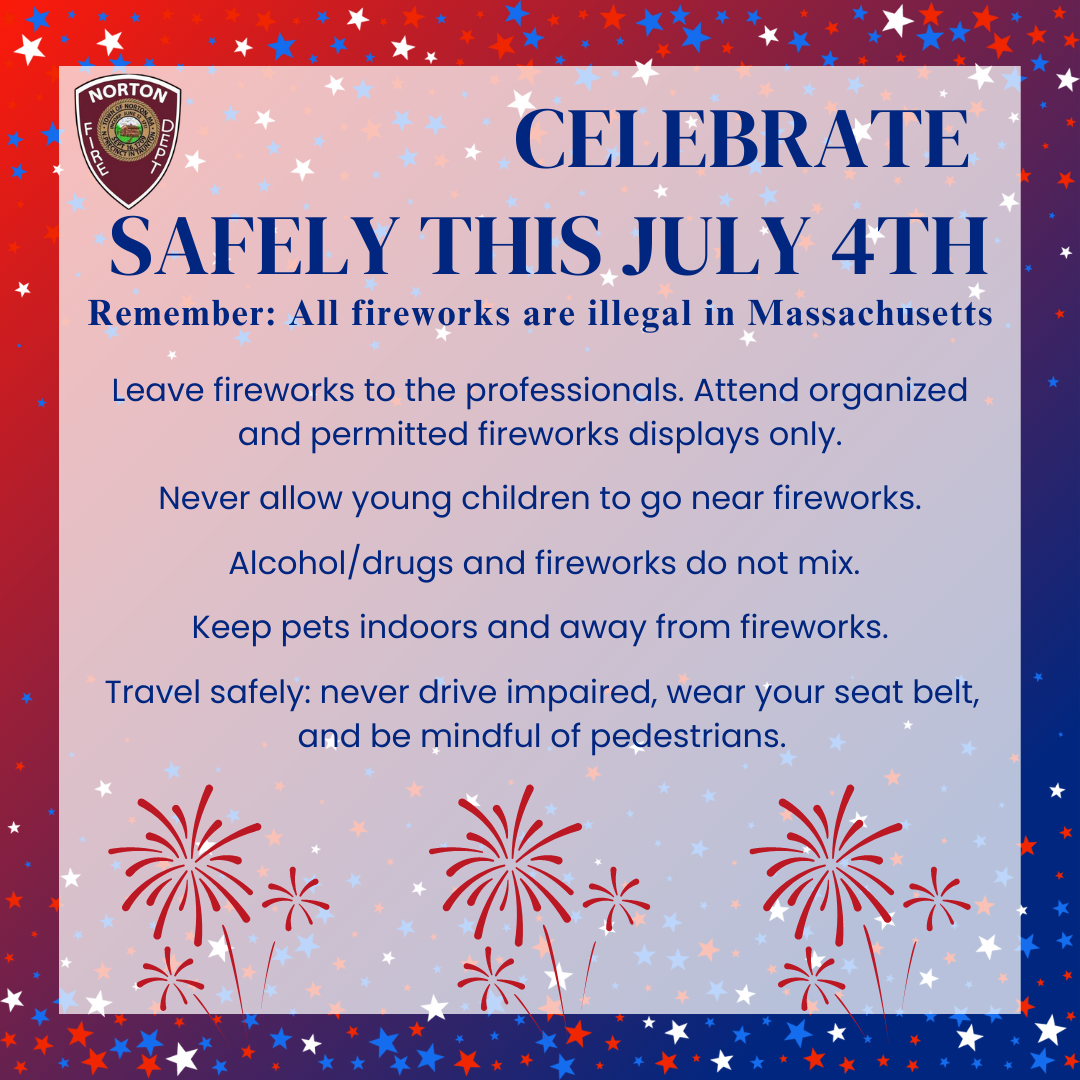
Possession or Use of Fireworks is Illegal in Massachusetts

Fire Chief Shawn Simmons wishes to share several important safety tips and reminders as residents prepare to celebrate the Fourth of July holiday.

According to the state Department of Fire Services and State Police, Massachusetts fire departments reported nearly 1,000 fires related to illegal fireworks between 2013 and 2022. In addition to the 42 fire service injuries, five civilian injuries, and $2.5 million in damages attributed to these fires, Massachusetts medical facilities reported about 30 severe burn injuries extending to 5% or more of the victims’ bodies that were caused by illegal fireworks. In 2022 alone, fire departments reported 106 fires and explosions attributed to fireworks, an increase of nearly a third over the prior year.

It is illegal for private citizens to use, possess, or sell fireworks of all kinds in Massachusetts without a license and a permit. This includes fireworks purchased legally elsewhere and brought into Massachusetts. It includes sparklers, firecrackers, cherry bombs, and other fireworks. Fines range from $10 to $1,000, and some violations could carry a one-year prison sentence.

Additionally, residents are reminded of these key safety tips for Fourth of July celebrations:

  • Attend organized and permitted fireworks displays only.
  • Report illegal fires to the police.
  • Remember that alcohol/drugs and fireworks do not mix.
  • Never allow young children to go near fireworks.
  • Keep pets indoors and away from fireworks. The loud noises and flashing lights can be frightening and overwhelming for pets. Pets can become frightened and run from familiar environments and people, becoming lost. Read more here.

The department also urges residents to observe the following tips from the National Highway Traffic Safety Administration on getting home safely following Fourth of July celebrations:

  • Be mindful of pedestrians.
  • Always wear your seatbelt.
  • Do not drive under the influence of drugs or alcohol. From 2017 to 2021, 1,460 drivers were killed in motor vehicle crashes over the Fourth of July holiday period — 38% of the drivers killed were drunk.
  • Even if you’ve had only one alcoholic beverage, do not plan on driving. Instead, designate a sober driver or use a ride-share service to get home safely.
  • Take keys away from individuals who are under the influence and are planning to drive. Alcohol and drugs impair perception, judgment, motor skills, and memory, which are critical for safe and responsible driving.
  • If you see an impaired driver on the road, safely pull over and call 911.

In case of a firework-related or other emergency, always dial 911.

The men and women of the Norton Fire Department wish everyone a happy Fourth of July!

###

Norton Fire Department Awarded Fire Prevention Grant from FM Global

Norton Fire Department Awarded Fire Prevention Grant from FM Global

Chief Shawn Simmons is pleased to announce that the Norton Fire Department was awarded a grant from FM Global to bolster the department’s fire prevention efforts.

FM Global, one of the world’s largest commercial property insurers, presented a $3,570 fire prevention grant award to Chief Simmons on Monday, April 24 at the station headquarters.

The grant award will be used to purchase two iPads to assist with pre-incident fire planning. Funds from the grant also will be used to update the department’s Sparky the Fire Dog costume.

“We’re very thankful to FM Global for its generous grant award,” said Chief Simmons. “With this award, we will be able to purchase additional technology for our department that will assist us in better preparing ourselves ahead of emergency responses.”

Through its Fire Prevention Grant Program, FM Global awards grants to fire departments that best demonstrate a need for funding, where dollars can have the most demonstrable impact on preventing fire, or mitigating the damage it can quickly cause.

“At FM Global, we strongly believe the majority of property damage is preventable, not inevitable,” said Michael Spaziani, assistant vice president/manager of the fire prevention grant program. “Far too often, inadequate budgets prevent those organizations working to prevent fire from being as proactive as they would like to be. With additional financial support, grant recipients are actively helping to improve property risk in the communities they serve.”

To learn more about FM Global’s Fire Prevention Grant Program and other resources for the fire service, please visit www.fmglobal.com/fireservice.

###

Norton Fire Attends FCAM’s Annual Professional Development Conference

Norton Fire Attends FCAM’s Annual Professional Development Conference

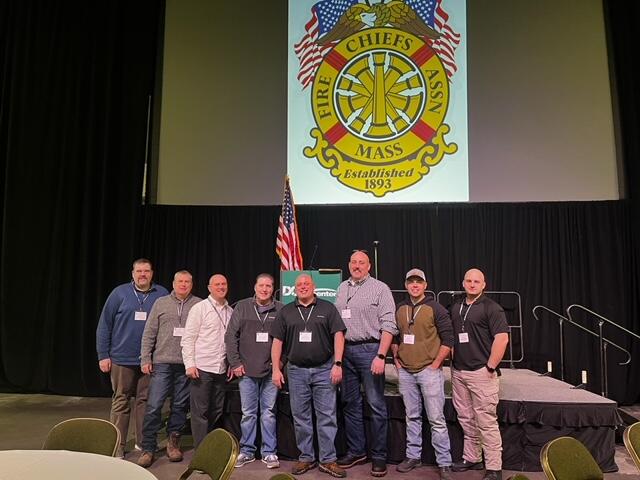
Members of the Norton Fire Department recently attended the Fire Chiefs Association of Massachusetts’ (FCAM) Annual Professional Development Conference at the DCU Center in Worcester from Feb. 28 to March 2.

Norton Fire joined nearly 500 fire and EMS leaders and personnel from across the state and hundreds of vendors from across the nation attending the three-day event. There were 16 speaking sessions, including keynote speakers and breakout sessions throughout the week.

Keynote speakers included Gen. John F. Kelly, Chief of Staff at the White House under President Donald Trump and former U.S. Secretary of Homeland Security, and Dr. Denis Onieal, former Deputy U.S. Fire Administrator. Other keynote speakers included Deputy Chief Phil Jose (ret.) of the Seattle Fire Department, and Deputy Chief Frank Viscuso (ret.) of the Kearny Fire Department in New Jersey.

Breakout sessions include presentations by Jake Wark, Public Information Officer for the Massachusetts Department of Fire Services; Dr. Henry Crowley, on the importance of simulation and cadavers in training; Tim Moore and Matt Brennan, on various grant programs; and John Guilfoil, founder and principal owner of John Guilfoil Public Relations, speaking about the importance of communications and PR for fire departments.

###