
Norton Fire Department welcomes new Firefighters (L-R) Devin Hunter, Evan Willard, Joshua DiCicco. These newest members once fully trained, will fill 3 open positions from retirements.

Official Website
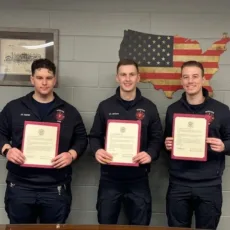
Norton Fire Department welcomes new Firefighters (L-R) Devin Hunter, Evan Willard, Joshua DiCicco. These newest members once fully trained, will fill 3 open positions from retirements.
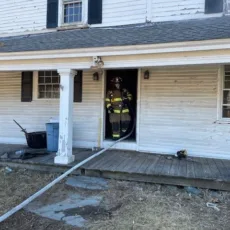


Group 4 training today at a house on Taunton Ave. The Norton Fire Department thanks the owners for allowing us to utilize this structure for training exercises prior to demolition.


Chief Shawn Simmons and the Norton Fire Department remind residents to check their smoke and carbon monoxide alarms when setting their clocks ahead for Daylight Saving Time this weekend.
Daylight Saving Time begins at 2 a.m. on Sunday, March 10, and clocks will be moved ahead one hour at that time.
Smoke alarms that are properly installed and maintained are crucial life-saving devices that allow time to escape in the event of a fire. According to the National Fire Protection Association (NFPA), from 2014-2018, almost three out of every five home fire deaths resulted from fires in homes with no smoke alarms (41%) or no working smoke alarms (16%).
The risk of dying in reported home structure fires is 55% lower in homes with working smoke alarms than in homes with no alarms or none that worked, according to the NFPA.
Furthermore, according to the Centers for Disease Control and Prevention, each year, more than 400 people in the U.S. die from unintentional CO poisoning not linked to fires, more than 100,000 visit the emergency room, and more than 14,000 are hospitalized.
Residents are encouraged to review the following safety tips, courtesy of the NFPA, to keep their homes and loved ones safe:
The NFPA also notes that today’s smoke alarms are more technologically advanced to respond to a multitude of fire conditions, yet mitigate false alarms. Residents are reminded that smoke and carbon monoxide alarms are not interchangeable and should never be disconnected.
For additional information on installing and maintaining smoke alarms, click here. For additional information on CO alarm safety, click here.
###
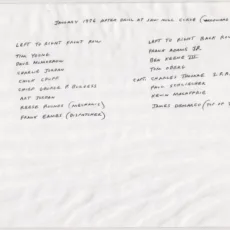


Can you identify these Retired/Late Norton Firefighters? We will be posting pictures sporadically on our new tab “NFD Through the Years” at the top of our homepage and located here – https://nortonfire.com/nfd-through-the-years/ If you can identify them, please fill out the link and submit. We will post the names next week.


The Norton Fire and Police Department participated in a 2 day training class on Active Shooters. A special Thanks to Lt Jason Brennan from Medway Police Department, and Whole Foods Warehouse for allowing this training to take place at their facility.

NORTON— Chief Shawn Simmons is pleased to report that the Norton Fire Department received a $13,917.98 grant from the Department of Fire Services Fiscal Year 2024 Firefighter Safety Equipment Grant Program.
The Norton Fire Department will use the funding to purchase structural firefighting gear.
Fire departments across Massachusetts were invited to apply to the Firefighter Safety Equipment Grant program, which provides reimbursement on purchases of 135 different types of eligible equipment. Eligible items include hoses and nozzles, turnout gear, ballistic protective equipment, gear washers and dryers, thermal imaging cameras, hand tools and extrication equipment, communications resources, hazardous gas meters, and more. In many cases, the purchase of this equipment will help departments attain compliance with Occupational Safety & Health Administration or National Fire Protection Association safety standards. This is the fourth year that funding has been awarded through the program.
“The Firefighter Safety Equipment Grants are an investment in the health and safety of Massachusetts firefighters,” said State Fire Marshal Jon Davine. “The flexibility of the program is especially valuable because it allows each department to make purchases based on their specific needs and resources. It has become a vital part of the way the Massachusetts fire service prepares for the constantly evolving threats in the world around us.”
###

The Norton Fire Department congratulates Rev. Bernard Hinckley on his 25th Anniversary of Ordination. Rev. Hinckley also serves as the Norton Fire Department Chaplain. Thank you Bernie for all you do for the Norton Fire Department and its members both past and present, we hope you are with as as Fire Chaplain for another 25 years!
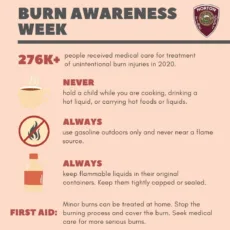
Chief Shawn Simmons and the Norton Fire Department would like to share safety tips with the community as a part of National Burn Awareness Week.
Burn Awareness Week, organized by the American Burn Association (ABA), began this year on Sunday, Feb. 4, and ends on Saturday, Feb. 10. This annual campaign serves as an opportunity for fire officials to share common burn prevention messages with their communities.
The 2024 Burn Awareness Week theme is flammable liquid burns.
According to the ABA, 276,086 people received medical care for treatment of unintentional burn injuries in 2020. The primary causes of injury include fire, scalds, and contact with hot objects, electricity and chemicals. Most of the injuries occur in the home.
Vapors from flammable and combustible liquids can ignite, causing a fire. There are many commonly used flammable liquids, including gasoline, lacquers, and nail polish. The following safety tips to prevent burns caused by flammable liquids are provided by the ABA and National Fire Protection Association:
Cooking Liquids
Gasoline
Other Flammable/Combustible Liquids
Burn Injuries
Minor burns can be treated at home. According to the ABA, initial first aid treatment includes:
Minor burns will usually heal without further treatment. If you have a significant burn injury it is important to seek treatment at a burn center. Several factors – like location and size – are important when treating burns. If you are unsure on the seriousness of an injury, review the ABA’s guidance on When to Seek Medical Care.
For more information on National Burn Awareness Week and flammable liquid burn injuries, visit the ABA website.
###